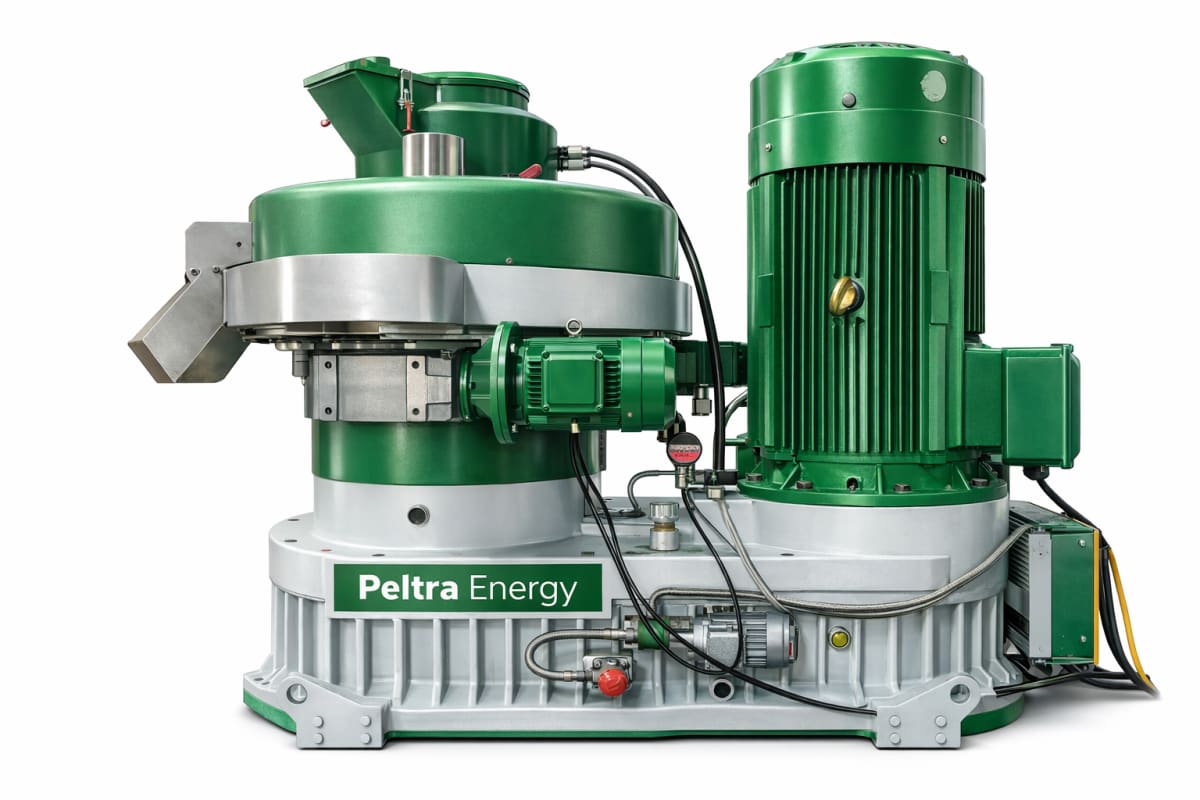
A pellet plant dries and grinds biomass, conditions it with heat and moisture, then forces it through a steel die under high pressure to form pellets. The pellets are cooled, screened, and packed. Plants are sized in tonnes per hour (TPH) to match your feedstock and output.
- A pellet plant dries, grinds, conditions, presses, cools, and packs biomass into finished fuel.
- The ring die is the heart of the line — it sets pellet size and drives quality and wear.
- Plants are rated in tonnes per hour (TPH); size them to your feedstock and output target.
What is a pellet plant?
A pellet plant is an integrated line of machines that converts raw biomass into finished biomass pellets. Each stage prepares the material for the next, and the whole line is rated by how many tonnes it can produce per hour.
The production line, step by step
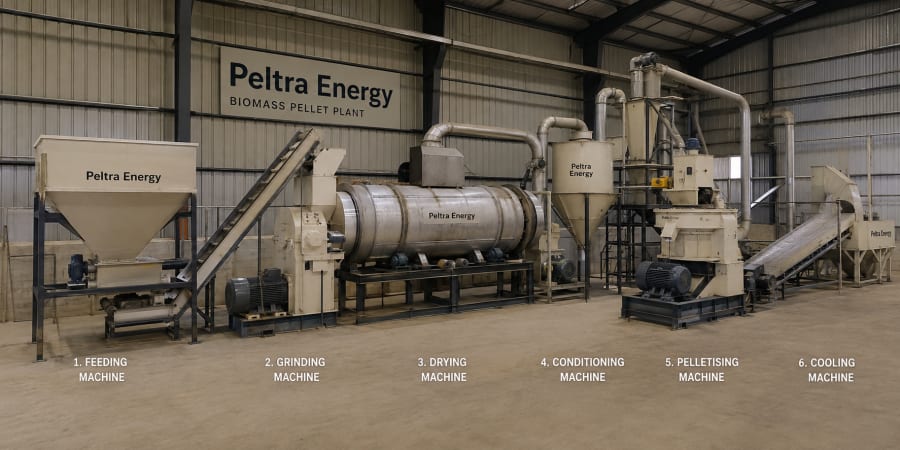
Six stages take raw residue to bagged fuel.
- 1
Feeding & drying
Biomass is metered in and dried to below 12% moisture so it binds and burns predictably.
- 2
Grinding
A hammer mill reduces the material to a fine, uniform particle size.
- 3
Conditioning
Steam or controlled moisture softens the natural lignin binder.
- 4
Pelletising
A pellet mill presses the material through a steel ring die under high pressure, forming dense cylinders.
- 5
Cooling
A cooler hardens the hot pellets and locks in their density.
- 6
Screening & packing
Fines are screened out and clean pellets are bagged or loaded in bulk.
Key components to know
Pellet mill & die
The heart of the plant — the ring die and rollers that form the pellets. Die quality drives output and lifespan.
Dryer
Brings feedstock to the right moisture. Essential when working with wet residue.
Hammer mill
Sizes the raw material so it densifies evenly.
Cooler & screener
Hardens pellets and removes fines for a clean, consistent product.
Choosing a capacity
Match the plant to your feedstock volume and output target.
| Plant | Approx. output | Best for |
|---|---|---|
| 1 TPH plant | ~24 tonnes/day | Small commercial start-ups |
| 2 TPH plant | ~48 tonnes/day | Growing operations |
| 5 TPH plantRecommended | ~120 tonnes/day | Industrial-scale supply |
| Custom plant | Tailored | Special feedstock or layout |
What affects a plant's real output
A plant's rated capacity assumes ideal feedstock. In practice, output depends on moisture, particle size, and the material itself — wet or fibrous biomass runs slower and wears the die faster than dry, uniform sawdust. Sizing the dryer and hammer mill to match your worst-case feedstock is what keeps a line hitting its rated tonnes per hour.
The ring die is the single biggest wear part and the biggest lever on quality. Die hole size sets pellet diameter, while die material and compression ratio decide how well different feedstocks bind. A plant matched to your specific residue runs longer between die changes and produces a denser, more consistent pellet — worth confirming before you choose a capacity.
What to look for when buying a plant
Die quality
The ring die drives output and pellet quality — the part that matters most.
Automation
Automatic feeding and controls cut labour and keep output steady.
Feedstock match
A line tuned to your residue runs longer between die changes.
After-sales support
Spares, service, and guidance keep a plant running for years.
Running a pellet plant as a business
The plants that make money get three contracts right: feedstock in, power, and offtake out. Lock feedstock supply around the harvest calendar so the line never starves, and secure buyers — boiler operators, traders, or bulk buyers — before commissioning, not after. A pellet line earns when it runs; utilisation is the whole game.
Quality consistency is the moat. Buyers pay steadily for a pellet that tests the same every month, and they leave quickly over one bad batch. Budget for a moisture meter and periodic lab tests from day one — they cost little against the tonnage they protect.
Share your feedstock and target output and we'll recommend a capacity and layout that fits.
From understanding to owning
A pellet plant is a chain of simple machines, but consistent, high-quality output depends on matching each stage — especially the dryer and die — to your feedstock. That fit is what separates a line that hits its rated capacity from one that struggles.
If you're planning a plant, explore our range or book a consultation for a capacity and layout recommendation.
Related reading: what biomass pellets are, types of pellets by feedstock, and biomass energy explained. For NABARD subsidy, DPR preparation, and a regional feasibility report before you invest, book a consultation.