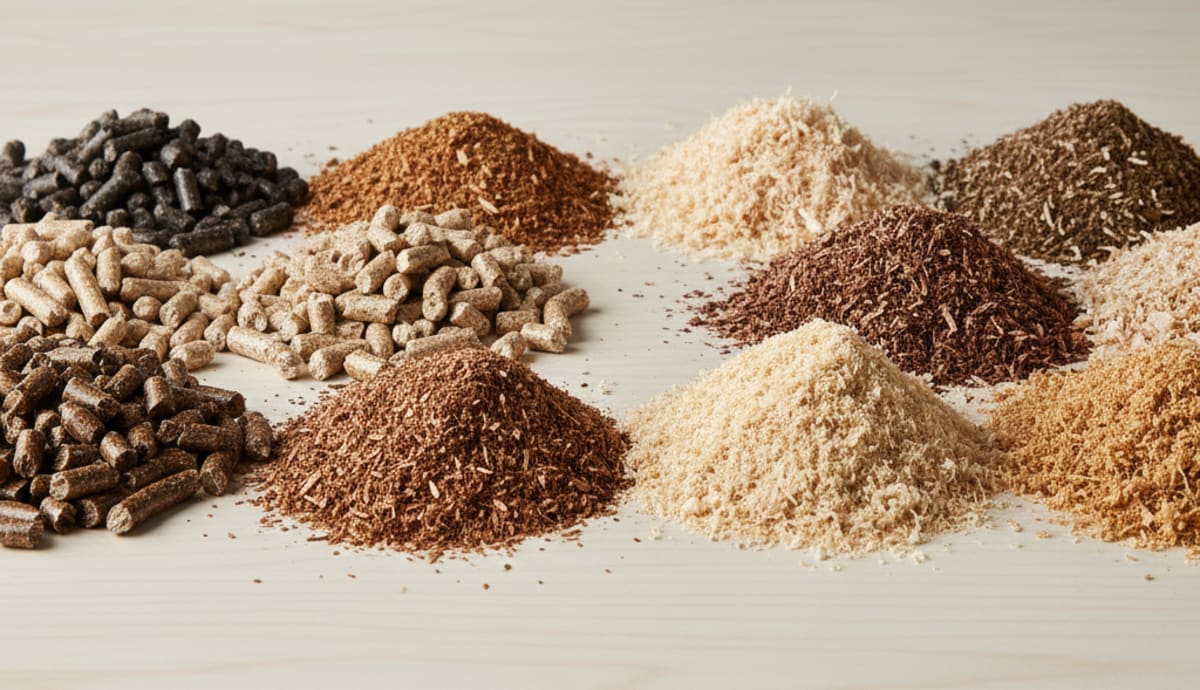
Biomass pellets are grouped by feedstock. Wood and hardwood pellets carry the most energy and least ash; agro-residue pellets (rice husk, straw, bagasse) cost less but run higher in ash. Match the type to your boiler and budget — or ask us for a recommendation.
- Every pellet shares one process; the feedstock sets its energy, ash, and price.
- Wood and hardwood pellets are high-energy and low-ash; agro-residue pellets are cheaper but higher-ash.
- Match the type to your boiler and local supply — trial two grades side by side if unsure.
One process, many feedstocks
Every pellet is dried, ground, and compressed the same way — the difference is what goes in. That single choice sets the calorific value, ash level, and price of the finished fuel.
Common types by feedstock
The pellets we supply, and where each fits:
Wood / pine pellets
High energy, very low ash — the premium boiler fuel. See pine wood pellets.
Rubberwood pellets
Dense hardwood pellets, popular as a clean mushroom substrate too.
Paddy straw pellets
Affordable agro-residue fuel and substrate — see paddy straw pellets.
Mango sawdust pellets
Fine hardwood sawdust pellets ideal for mushroom growing.
Rice husk pellets
Widely available and low-cost, with higher ash — suited to robust industrial boilers.
Bagasse pellets
Made from sugarcane residue — a steady, renewable agro-fuel.
Wood vs agro-residue pellets
The trade-off in one view.
| Factor | Wood pellets | Agro-residue pellets |
|---|---|---|
| Calorific valueRecommended | 4,000–4,800 kcal/kg | 3,000–4,200 kcal/kg |
| Ash content | < 1.5% | 5–20% |
| Relative cost | Higher | Lower |
| Best for | Premium / low-ash boilers | Cost-sensitive industrial heat |
How to choose the right type
Start with your boiler and your priority. If you need the cleanest, highest-energy burn with low ash handling, wood or hardwood pellets are worth the premium. If fuel cost is the main driver and your system tolerates more ash, agro-residue pellets like rice husk or paddy straw deliver heat at a lower rate.
Then factor in local supply — a pellet made from a residue that is abundant near you is cheaper and more reliably stocked. When in doubt, ask us to compare grades or trial two side by side in your boiler and check ash, clinkering, and steam output before committing to a regular supply.
What to check before you buy
Calorific value
The energy per kg — higher means more heat from every tonne of fuel.
Moisture
Under 10% for a clean, efficient burn and long, safe storage.
Ash content
Lower ash means less slag, less cleaning, and less to dispose of.
Durability & fines
Hard, low-dust pellets feed smoothly and waste less in transit.
Matching pellet type to your industry
Different industries lean toward different pellets. Clean, low-ash wood pellets suit sensitive processes — food and dairy, pharmaceuticals, and boilers where ash handling is a nuisance. Higher-ash agro-residue pellets are at home in robust industrial boilers, brick and ceramic kilns, and textile or dyeing units where cost per unit of heat is the priority.
Power plants and co-firing units usually take whatever delivers the best energy per rupee, blending grades to balance cost and ash. If you're not sure where your process fits, tell us your application and we'll point you to the right grade.
Specifications that matter when ordering
Whatever the feedstock, a pellet order should pin down four specs: diameter (6, 8, or 10 mm to suit your feed system), moisture (under 10%), ash class, and stated GCV. Suppliers quoting all four, backed by a recent test report, are quoting a fuel — anyone quoting only a price is quoting a gamble.
Blends are also common: mixing a share of wood pellets into agro-residue fuel lifts energy and lowers average ash at a middle price. If your boiler is sensitive to clinker, ask about ash behaviour for the specific feedstock before you buy.
Tell us your application and monthly volume, and we'll recommend the right grade.
Choosing with confidence
The best pellet is simply the one that matches your boiler, your budget, and what's available near you. Wood pellets win on cleanliness and energy; agro-residue pellets win on price — and both do the same job of replacing coal.
Not sure which fits? Ask our team or browse the full range to compare grades side by side.
Related: calorific value by feedstock, paddy straw pellet prices, and pellets vs briquettes.