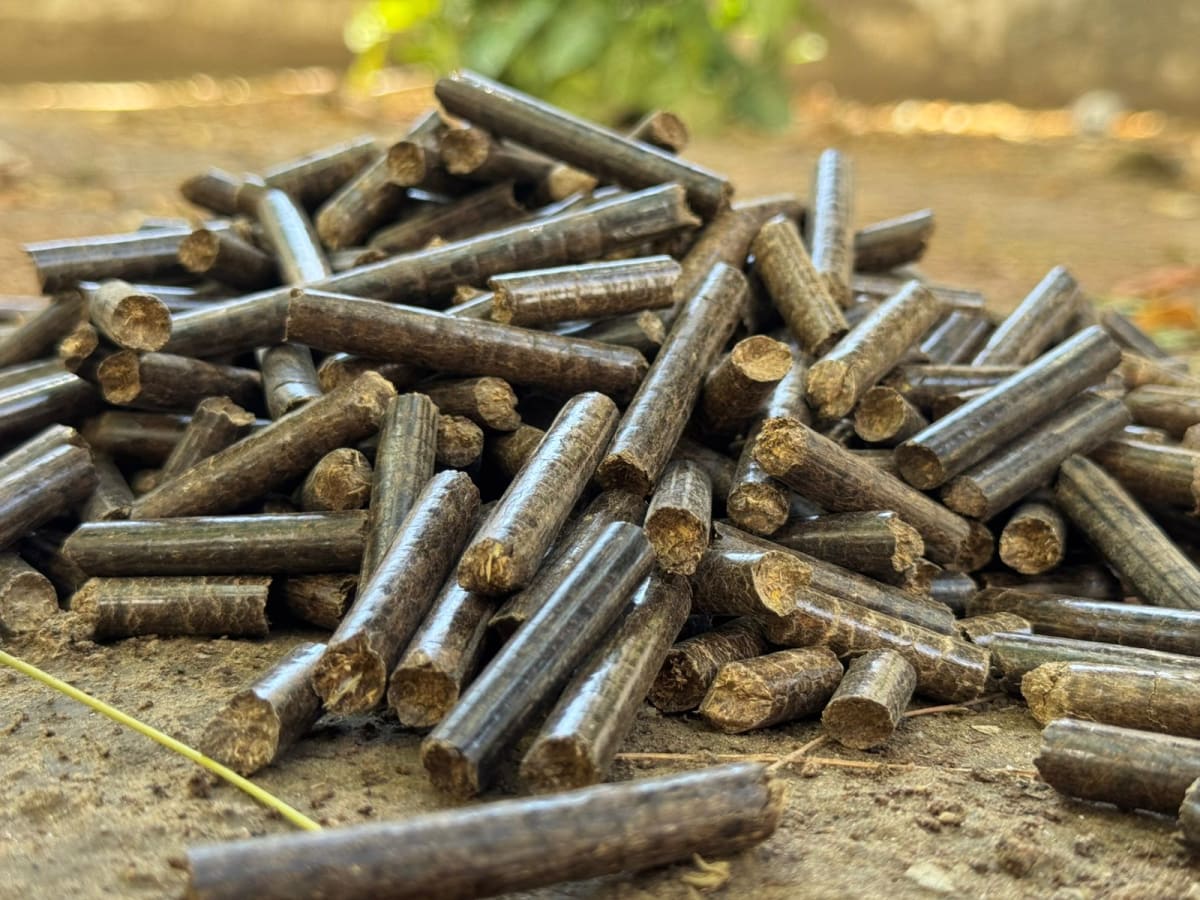
Biomass pellets are 6–12 mm compressed cylinders made from dried, ground biomass. They hold 3,800–4,800 kcal/kg of energy, carry under 10% moisture, and serve as a renewable replacement for coal and furnace oil in boilers, kilns, and power plants.
- Biomass pellets are 6–12 mm cylinders of compressed wood or crop residue, bound by natural lignin — no glue or chemical binder.
- They hold 3,800–4,800 kcal/kg, carry under 10% moisture, and feed automatically into modern boilers.
- A renewable, low-ash replacement for coal and furnace oil in boilers, kilns, and power plants.
What exactly is a biomass pellet?
A biomass pellet is a small, hard cylinder of organic material that has been dried, ground, and compressed under high pressure. The heat of compression releases lignin — a natural resin in plant tissue — which sets as the pellet cools and holds it together without any added glue or chemical binder.
The result is a fuel that is uniform, dry, and energy-dense. Because every pellet is roughly the same size and moisture level, it burns far more predictably than loose biomass and can be fed automatically into modern combustion systems.
What are biomass pellets made from?
Almost any dry agricultural or forestry residue can be pelletised. In India, the most common feedstocks are by-products that would otherwise be burned in the open or left to waste:
How biomass pellets are made
Pelletising follows a fixed sequence — each step prepares the material for the next:
- 1
Collection & drying
Raw biomass is gathered and dried to below 12% moisture so it binds and burns predictably.
- 2
Grinding
A hammer mill reduces the material to a fine, uniform particle size ready for densification.
- 3
Conditioning
Controlled heat and moisture soften the lignin — the plant's own natural binder.
- 4
Pelletising
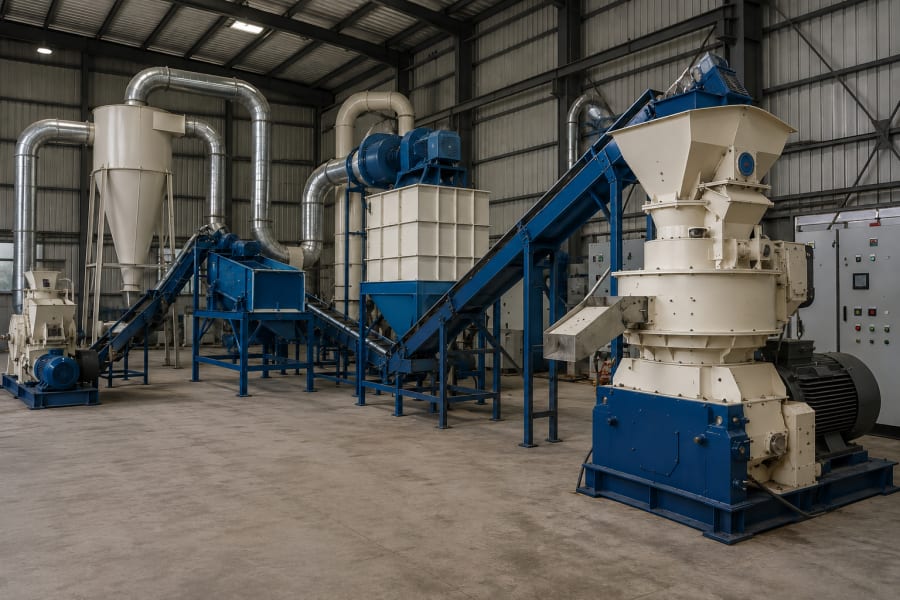
A pellet mill forces the material through a steel die under high pressure, forming dense cylinders.
- 5
Cooling & screening
Pellets are cooled to harden, then screened to remove fines for a clean, consistent product.
- 6
Packing
Finished pellets are bagged or supplied in bulk, ready to fire in boilers, kilns, and gasifiers.
Key properties at a glance
These four numbers decide how a pellet performs and what it's worth. Exact figures vary with feedstock and grade.
Calorific value
Higher for wood, lower for agro-residue
Moisture content
Far drier than raw biomass
Ash content
Under 1.5% for clean wood pellets
Bulk density
Compact to store and transport
Why industries are switching
Renewable & low-carbon
Made from waste biomass that would otherwise be burned in fields or sent to landfill.
High, consistent energy
Uniform size and low moisture give a steady, efficient burn versus loose biomass.
Easy to store & handle
Dense, free-flowing, and compact — they ship and stack far more efficiently than briquettes or raw fuel.
Cost-effective fuel
A competitive, price-stable alternative to coal and furnace oil for thermal needs.
Cleaner combustion
Lower ash and emissions than coal, helping plants meet pollution-control norms.
Drop-in for boilers
Work in most existing biomass and multi-fuel boilers with little or no modification.
Where biomass pellets are used
From heavy industry to mushroom farms, pellets show up wherever clean, controllable heat — or a consistent organic substrate — is needed.
Pellets vs other fuels
How biomass pellets stack up against briquettes, raw biomass, and coal on the factors that matter most.
| Fuel | Size | Moisture | Feeding | Best for |
|---|---|---|---|---|
| Biomass pelletsRecommended | 6–12 mm | < 10% | Fully automatic | Boilers, gasifiers, co-firing |
| Biomass briquettes | 60–90 mm | < 12% | Manual / semi-auto | Bulk furnaces, kilns |
| Raw biomass | Loose / irregular | 20–50% | Manual | Low-efficiency burning |
| Coal | Lumps | Variable | Mechanical | High-emission heat |
How to store and handle biomass pellets
Biomass pellets are easy to store, but they have one enemy: moisture. Because they're dried below 10% and held together by lignin rather than glue, damp air makes them swell, crumble, and lose calorific value. Keep them under cover, off the ground, and away from standing water.
For bulk users, a dry silo or covered shed with good airflow keeps pellets stable for months. Bagged pellets should sit on pallets, not bare floors. Handle them gently — repeated dropping and augering creates fines (pellet dust) that can clog feeders and cut combustion efficiency.
Are biomass pellets good for the environment?
Biomass pellets are considered carbon-neutral in use: the carbon released when they burn is the same carbon the plants absorbed while growing, so they add little net CO₂ to the atmosphere — unlike coal, which releases carbon locked away for millions of years.
There's a second win. Much of India's pellet feedstock is crop residue that would otherwise be burned in open fields, a major source of seasonal air pollution. Turning that residue into fuel keeps it out of the open air and puts it to productive use. See how pellets compare with coal.
How to judge biomass pellet quality
Good pellets look and behave the same, bag after bag. On delivery, check four things: moisture (a dry pellet snaps cleanly rather than crumbling), fines (excess dust at the bottom of a bag means weak pellets), colour consistency (a uniform batch burns predictably), and smell (a sour or musty odour signals damp storage). For bulk contracts, ask for a recent proximate analysis covering moisture, ash, volatile matter, and calorific value.
Durability matters as much as energy. Pellets that break down in handling clog augers and burn unevenly. A simple field test: shake a handful in a closed jar — premium pellets stay intact with little dust. If you are comparing suppliers, test-fire a small batch before signing a tonnage agreement.
Browse grades by feedstock, or send us your monthly tonnage for a bulk quote.
The bottom line
Biomass pellets turn low-value residue into a clean, uniform, high-density fuel that behaves predictably in modern equipment. For industries under pressure to cut emissions and fuel costs at once, they are one of the simplest switches available.
If you're weighing a move, start by matching a grade to your boiler — browse our pellets — or send your monthly requirement for a bulk quote.
Go deeper: types of pellets by feedstock, calorific value explained, and pellets vs briquettes. Thinking of producing pellets as a business? See how a pellet plant works, then book a consultation for feasibility, subsidy, and DPR support.