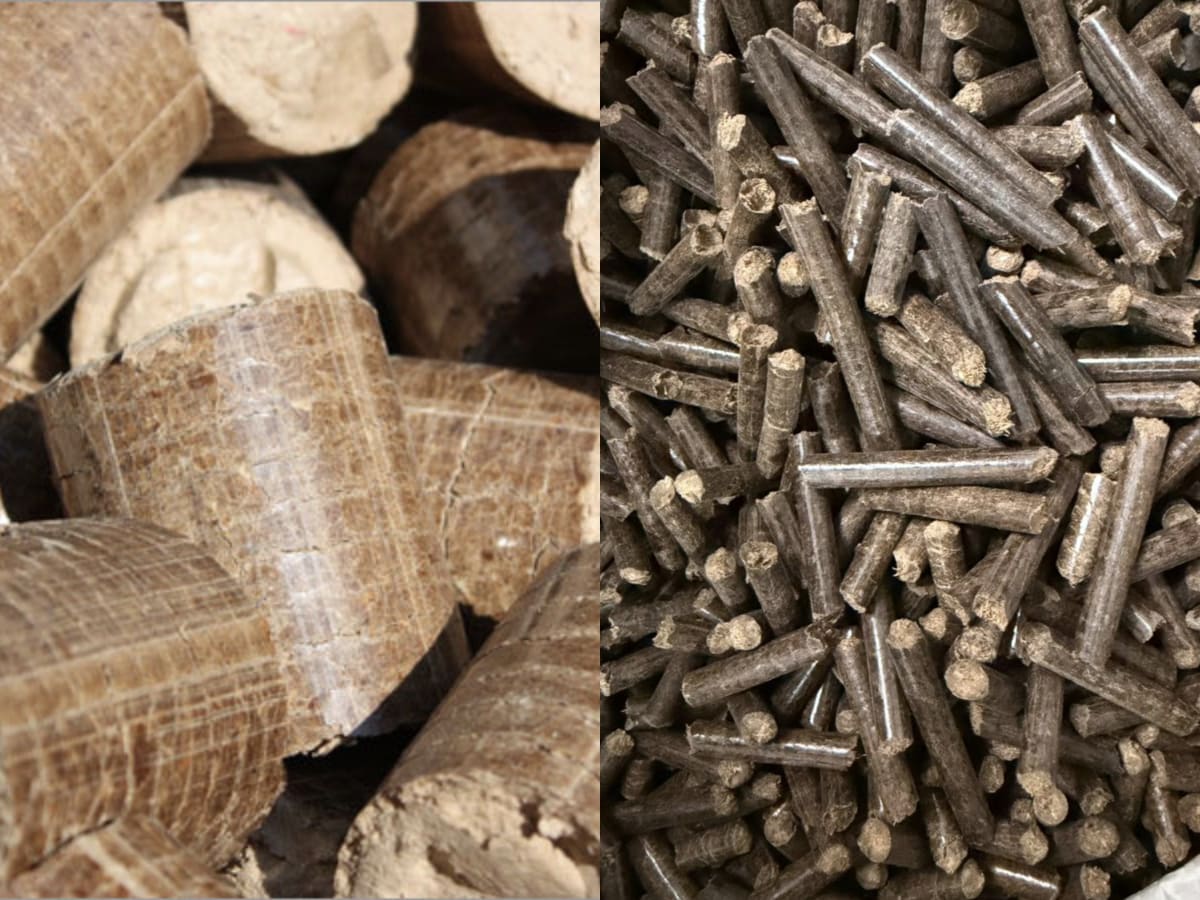
Choose pellets if you run an automatic-feed boiler or gasifier and want a consistent, low-moisture fuel. Choose briquettes if you fire a large furnace or kiln manually and want a lower-cost fuel in bulk. Both deliver similar energy per kilogram.
- Both are densified biomass; pellets are small (6–12 mm) and auto-fed, briquettes are large (60–90 mm) and hand-loaded.
- Pellets suit automatic boilers and gasifiers; briquettes suit large furnaces and kilns.
- Energy is similar (3,500–4,800 kcal/kg) — choose by how your system feeds fuel, not by heat.
Same idea, two formats
Densification turns loose, bulky biomass into a dense, dry, easy-to-handle fuel. Both pellets and briquettes use the plant's own lignin as a binder, so neither needs added glue.
The split is mechanical. Pellets are forced through a small ring-die at very high pressure, producing uniform cylinders 6–12 mm across. Briquettes are pressed by a screw or piston into much larger blocks, typically 60–90 mm across. That single difference drives everything else.
Side by side
How the two densified fuels compare on the factors that decide cost and convenience.
| Factor | Pellets | Briquettes |
|---|---|---|
| Size | 6–12 mm dia | 60–90 mm dia |
| Bulk density | 600–700 kg/m³ | 550–650 kg/m³ |
| Moisture | < 10% | < 12% |
| FeedingRecommended | Fully automatic | Manual / semi-auto |
| Calorific value | 3,800–4,800 kcal/kg | 3,500–4,500 kcal/kg |
| Best for | Boilers, gasifiers | Kilns, large furnaces |
When pellets win
Automatic feeding
Their small, uniform size flows through augers and screw feeders, so boilers can run hands-off.
Consistent burn
Tight size and low moisture give a steady, predictable flame — ideal for process heat that can't fluctuate.
Denser handling
Free-flowing and slightly denser, so they store and transport efficiently in silos and bulk bags.
When briquettes win
Lower fuel cost
Simpler to produce, so the per-tonne price is often lower where automation isn't needed.
Long, steady heat
Their larger mass burns slowly and steadily — well suited to brick kilns and big furnaces.
Manual-friendly
Easy to load by hand in plants without feeding systems or where labour is readily available.
Cost and logistics in practice
Beyond the machine that feeds them, the two fuels differ in how they move and store. Pellets flow like grain — they fill silos, hoppers, and bulk bags, and can be conveyed automatically from store to boiler. Briquettes stack like firewood and are usually moved by hand or loader, which suits plants that already run on manual labour.
On cost, briquettes are simpler to make and often cheaper per tonne, while pellets repay their premium wherever automation cuts labour and steadier combustion lifts boiler efficiency. The honest comparison is cost per tonne of steam, not cost per tonne of fuel.
If your system feeds fuel by machine, buy pellets. If you load fuel by hand into a large furnace or kiln, briquettes usually cost less for the same heat.
Which one should you buy?
There's no single winner — the right densified fuel depends entirely on how your equipment feeds and burns. Automatic systems want pellets; hand-fed furnaces and kilns often do better on briquettes.
Still unsure? Tell us your setup and we'll recommend the format and grade, or browse pellets to compare options.
New to densified fuel? Start with what biomass pellets are, compare pellet types by feedstock, and check calorific values before you commit to a grade. Planning to manufacture rather than buy? Book a consultation.