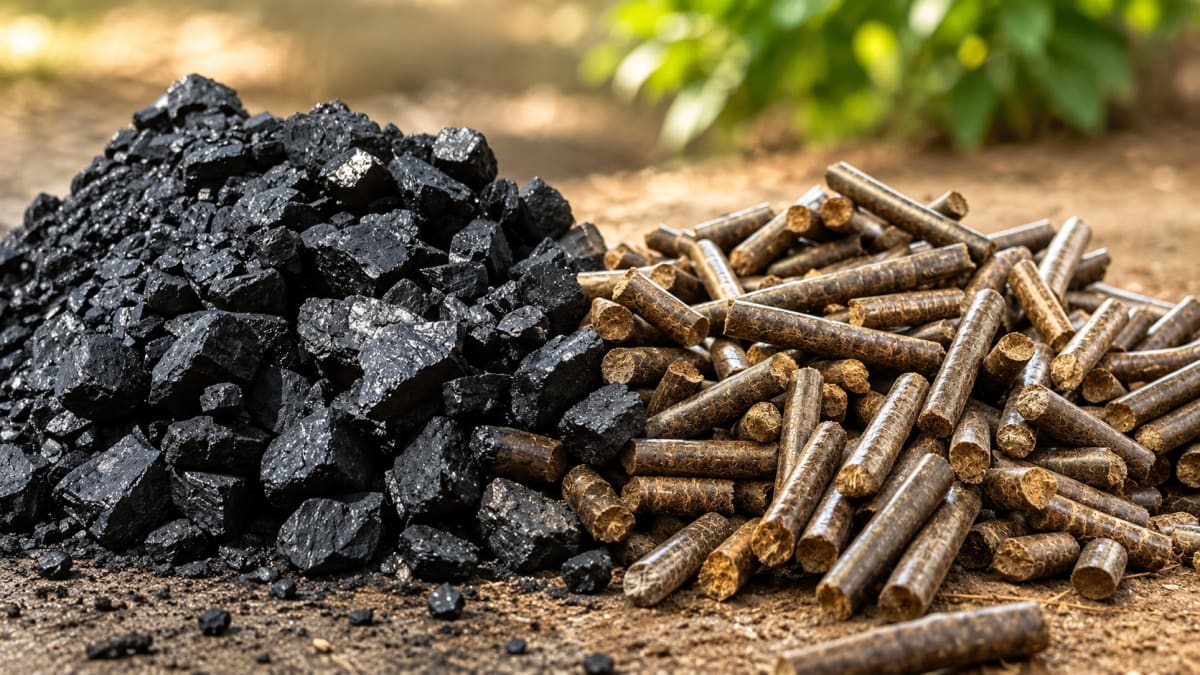
Biomass pellets are a renewable, low-emission fuel that can replace coal in most boilers with little modification. Coal packs slightly more energy per kilogram, but pellets burn far cleaner, produce less sulphur and ash, and help plants meet pollution-control norms.
- Pellets are renewable and far lower in ash and sulphur; coal carries slightly more energy per kilogram.
- Most biomass and multi-fuel boilers run pellets with little or no modification.
- Total cost favours pellets once cleaner combustion, lower ash disposal, and compliance are counted.
Why industries are moving off coal
Tightening emission norms and unpredictable coal supply have pushed Indian industries to look for a cleaner solid fuel. Biomass pellets — dense cylinders of compressed wood and crop residue — have become the practical answer.
The two fuels aren't identical. Coal carries more energy per kilogram, but pellets make up for it with lower ash, far lower sulphur, and a renewable, carbon-neutral profile. For most thermal users, delivered heat per rupee is competitive once cleaner combustion and compliance are factored in.
Biomass pellets vs coal, side by side
The factors that decide fuel choice for a boiler or kiln.
| Factor | Biomass pellets | Coal |
|---|---|---|
| SourceRecommended | Renewable (waste biomass) | Non-renewable (mined) |
| Calorific value | 3,800–4,800 kcal/kg | 4,000–6,000 kcal/kg |
| Ash content | 1–10% | 10–40% |
| Sulphur / emissions | Very low | High (SOx, particulates) |
| Feeding | Fully automatic | Manual / mechanical |
| Boiler fit | Drop-in for most biomass boilers | Legacy coal systems |
What you gain by switching
Renewable & compliant
A carbon-neutral fuel that helps meet pollution-control and ESG targets.
Cleaner combustion
Much lower sulphur, ash, and particulate emissions than coal.
Drop-in fuel
Works in most biomass and multi-fuel boilers with little or no retrofit.
Price-stable
Made from local residues, so it avoids the volatility of imported coal. Ask for a quote.
How to switch without disruption
Most plants move over in four steps, with no downtime.
- 1
Assess your boiler
Confirm your system can take pellets — most biomass and multi-fuel boilers already can.
- 2
Trial a batch
Run a small quantity to benchmark combustion and ash against your current coal.
- 3
Lock in supply
Fix a grade and tonnage so quality stays consistent across deliveries.
- 4
Scale up
Move to full pellet firing. Our team can guide sizing — talk to us.
It's more than the fuel bill
When plants compare coal and pellets on the sticker price alone, they miss half the picture. Pellets burn more completely, so less fuel is wasted as unburnt carbon, and they leave a fraction of the ash — which cuts disposal costs and boiler cleaning downtime.
There's a supply angle too. Coal prices swing with global markets and freight, while pellets are made from local crop and wood residue, so your fuel cost tracks the harvest rather than the international coal index. For many boilers, that predictability is worth as much as the headline rate.
Which industries benefit most
Textile & dyeing
Steady steam and process heat — a natural fit for pellet-fired boilers replacing coal.
Food & dairy processing
Clean, controllable heat for drying, boiling, and sterilising, without coal's ash and smoke.
Brick & ceramic kilns
High, sustained heat from a renewable fuel that helps meet tightening kiln norms.
Paper & chemical
Reliable steam for continuous processes, with predictable local fuel supply.
Emissions, compliance, and ESG
The regulatory gap between the two fuels is widening. Coal combustion releases sulphur oxides, higher particulate matter, and more ash — exactly the emissions state pollution-control boards are tightening limits on. Biomass pellets burn with far lower sulphur and particulates, so plants often clear norms with existing control equipment.
There's a reporting benefit too. Because biomass is renewable and carbon-neutral in use, switching cuts a facility's reported carbon footprint — increasingly important for companies with ESG or net-zero commitments, and for suppliers to buyers who track their supply-chain emissions.
Co-firing: the halfway step
You do not have to switch overnight. Co-firing — blending a share of biomass pellets into a coal-fired boiler — lets plants cut emissions in stages while proving the fuel on their own equipment. Many operations start at a modest blend, watch combustion and ash behaviour, and raise the biomass share as confidence grows.
It is the lowest-risk path off coal: no downtime, no leap of faith, and a clear data trail from your own boiler. If you are weighing a co-firing trial, our team can plan the blend and supply around your current coal schedule.
Send your boiler type and monthly fuel use and we'll put together a pellet plan and quote.
The bottom line on switching
For most industrial boilers, biomass pellets are the cleanest, simplest way to move off coal — renewable, low-ash, low-sulphur, and a drop-in for existing systems. Coal's small edge in energy density rarely outweighs the emissions, compliance, and handling advantages of pellets.
The best next step is a trial: benchmark a batch in your own boiler. We can set that up — get a fuel plan.
Related reading: what biomass pellets are, types by feedstock, and calorific value. Considering producing your own fuel instead of buying it? Book a consultation.